
What Is a D1 Minibus Licence?
A Category D1 licence is the UK driving licence entitlement that allows you to drive a minibus — a vehicle with between 9 and 16 passenger seats (excluding the driver). It is issued by the DVLA and administered by the DVSA. The D1 category sits within the broader passenger-carrying vehicle (PCV) licence family, which also includes Category D (full bus and coach) and Category D+E (bus and trailer).
Unlike a standard car licence, a D1 licence requires you to pass a dedicated medical examination, a theory test, and a practical driving test specifically designed for minibus-sized vehicles. It also requires you to hold a Driver CPC qualification if you intend to drive commercially.
Who Needs a D1 Licence?
You need a Category D1 licence if you want to drive a minibus in any of the following situations:
- You are being paid to drive — for example, as a minibus driver for a school, care home, or transport company.
- You are driving for hire or reward — passengers are paying for the journey.
- The minibus exceeds 3,500 kg MAM and you hold a post-1997 driving licence.
- You want to drive commercially without restriction.
If you are only driving voluntarily (not for payment) and the vehicle is under 3,500 kg MAM, you may be able to drive on a car licence. See our guide: Do I Need a D1 Licence to Drive a Minibus?
What Vehicles Does D1 Cover?
| Category | Vehicle Type | Passenger Seats |
|---|---|---|
| D1 | Minibus | 9–16 (excluding driver) |
| D1+E | Minibus with trailer | 9–16 + trailer |
| D | Full bus / coach | 17+ (excluding driver) |
| D+E | Bus / coach with trailer | 17+ + trailer |
D1 Licence Requirements
To apply for a Category D1 provisional entitlement and begin training, you must meet the following requirements:
- Age: You must be at least 18 years old (21 if driving for hire or reward).
- Existing licence: You must hold a full Category B (car) driving licence.
- Medical: You must pass a DVLA D4 medical examination, completed by a registered GP or approved medical practitioner.
- Eyesight: You must meet the higher Group 2 eyesight standard — you must be able to read a number plate at 20 metres.
- Health: Certain medical conditions may affect eligibility. The DVLA publishes detailed guidance on medical standards for Group 2 licences.
The D1 Licence Process Step by Step
Getting your D1 licence involves the following stages:
- D4 Medical Examination — Completed by your GP or a private medical provider. The completed D4 form is submitted to the DVLA with your licence application. Cost: £50–£150.
- DVLA Application — Apply for D1 provisional entitlement using form D2. DVLA fee: £55.
- Theory Test — Pass the PCV multiple-choice test (85/100 pass mark from 100 questions) and hazard perception test (67/100 from 19 clips). Cost: £26.
- Driver CPC Module 2 — If driving commercially, pass the case study theory test. Cost: £23.
- Practical Training — Complete practical training with an approved instructor. Duration varies by experience: typically 3–7 days.
- D1 Practical Test — Pass the DVSA practical driving test, which includes vehicle safety questions, an on-road driving assessment, and a reversing exercise. Cost: £115 (weekday) / £141 (weekend).
- Driver CPC Module 4 — If driving commercially, pass the practical demonstration test. Cost: £55.
D1 Theory Test: What to Expect
The D1 theory test uses the same PCV question bank as the full Category D test. The multiple-choice section has 100 questions and you need 85 to pass. Questions cover the Highway Code, vehicle safety, passenger safety, tachograph rules, driver hours legislation, and hazard awareness. The hazard perception section uses 19 video clips and requires a score of 67 out of 100.
The test is taken at a DVSA theory test centre. You can book online through the DVSA website. Most candidates prepare using the official DVSA revision materials and a combination of practice tests.
D1 Practical Test: What to Expect
The D1 practical test is conducted by a DVSA examiner and typically lasts around 90 minutes. It includes:
- Vehicle safety questions (Show Me / Tell Me): The examiner will ask you to demonstrate or explain checks such as how to check tyre pressure, how to test the horn, and how to check the emergency exit.
- On-road driving: Approximately 60 minutes of driving in a variety of road conditions, including town driving, rural roads, and dual carriageways where available.
- Reversing exercise: You will be asked to reverse the minibus into a defined area, demonstrating control and observation.
Common reasons for failing the D1 test include poor mirror use, incorrect speed planning, wide positioning on bends, hesitation at junctions, and insufficient clearance when passing cyclists or parked vehicles. See our guide: Top Reasons People Fail the D1 Minibus Test.
Do I Need Driver CPC for a D1 Licence?
Driver CPC is required if you drive a minibus commercially — that is, for hire or reward. If you are driving voluntarily (for example, as a school staff member or charity volunteer), you do not need Driver CPC. The CPC qualification consists of four modules: Module 1 (theory, multiple choice), Module 2 (case study), Module 3 (practical driving test), and Module 4 (practical demonstration). For D1 candidates, Modules 2 and 4 are the additional CPC elements on top of the standard D1 theory and practical tests.
How Long Does D1 Training Take?
Most candidates with a good standard of car driving complete D1 training in three to five days. Candidates who are less confident or who have not driven for some time may need a week or more. Test availability at DVSA test centres also affects overall timescale. For a full breakdown, see: How Long Does D1 Minibus Training Take?
How Much Does D1 Training Cost?
The total cost of getting a D1 licence typically ranges from £1,200 to £3,000 depending on the amount of training required and whether you need Driver CPC. For a full cost breakdown, see: D1 Minibus Training Cost: What You Need to Budget For.
D1 Training in Surrey with GS Driver Training
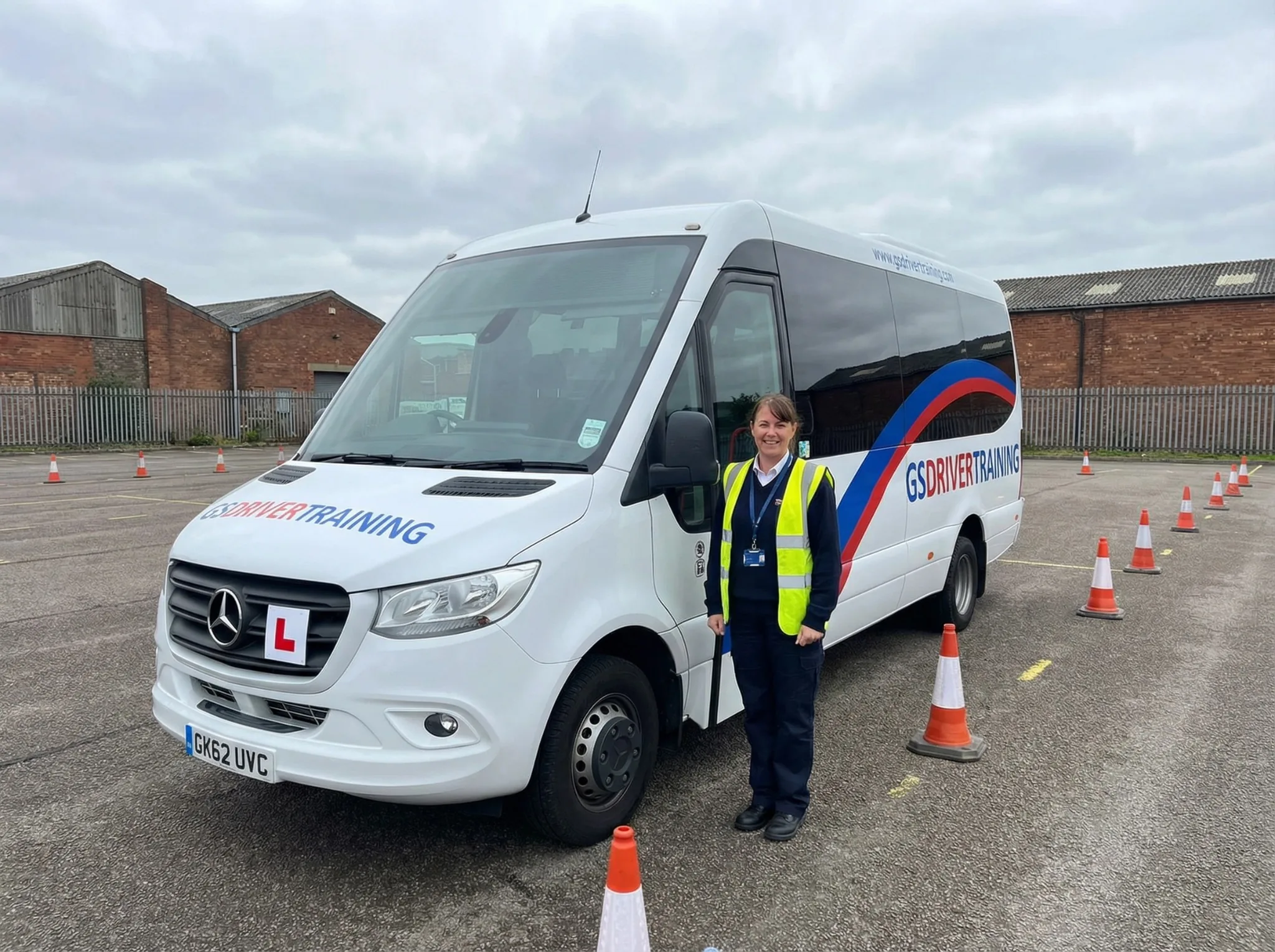
GS Driver Training provides Category D1 minibus training from our base in Surrey, serving Guildford, Woking, Farnham, Camberley, Aldershot, Redhill, Reigate, Epsom, Dorking, Leatherhead, and the wider South East. Our DVSA-approved instructors offer flexible training schedules to suit individuals, schools, care homes, and organisations. Male and female instructors are available.
Call us on 01252 447808 or email [email protected] to get started.
Frequently Asked Questions
Can I drive a minibus with a car licence?
In some circumstances, yes. If you are driving voluntarily, the vehicle is under 3,500 kg MAM, and no payment is involved, a car licence may be sufficient. See: Do I Need a D1 Licence to Drive a Minibus?
What is the minimum age for a D1 licence?
You must be at least 18 to hold a D1 provisional licence, but you must be 21 to drive for hire or reward.
How long is a D1 licence valid?
A D1 licence is valid until you turn 45, then until 65, and thereafter must be renewed every five years. Medical standards also apply at renewal.
