
Overview of the D1 Minibus Driving Test
The D1 minibus driving test is conducted by a DVSA examiner and typically lasts around 90 minutes in total. It is more demanding than the standard car driving test, reflecting the greater responsibility of driving a vehicle carrying up to 16 passengers. Understanding exactly what happens on the day — and what examiners are looking for — is one of the most effective ways to prepare.
Before the Test: What to Bring
On the day of your D1 test, you must bring:
- Your photocard driving licence (both parts if you have an older paper counterpart).
- Your theory test pass certificate (if it has not yet been added to your licence record).
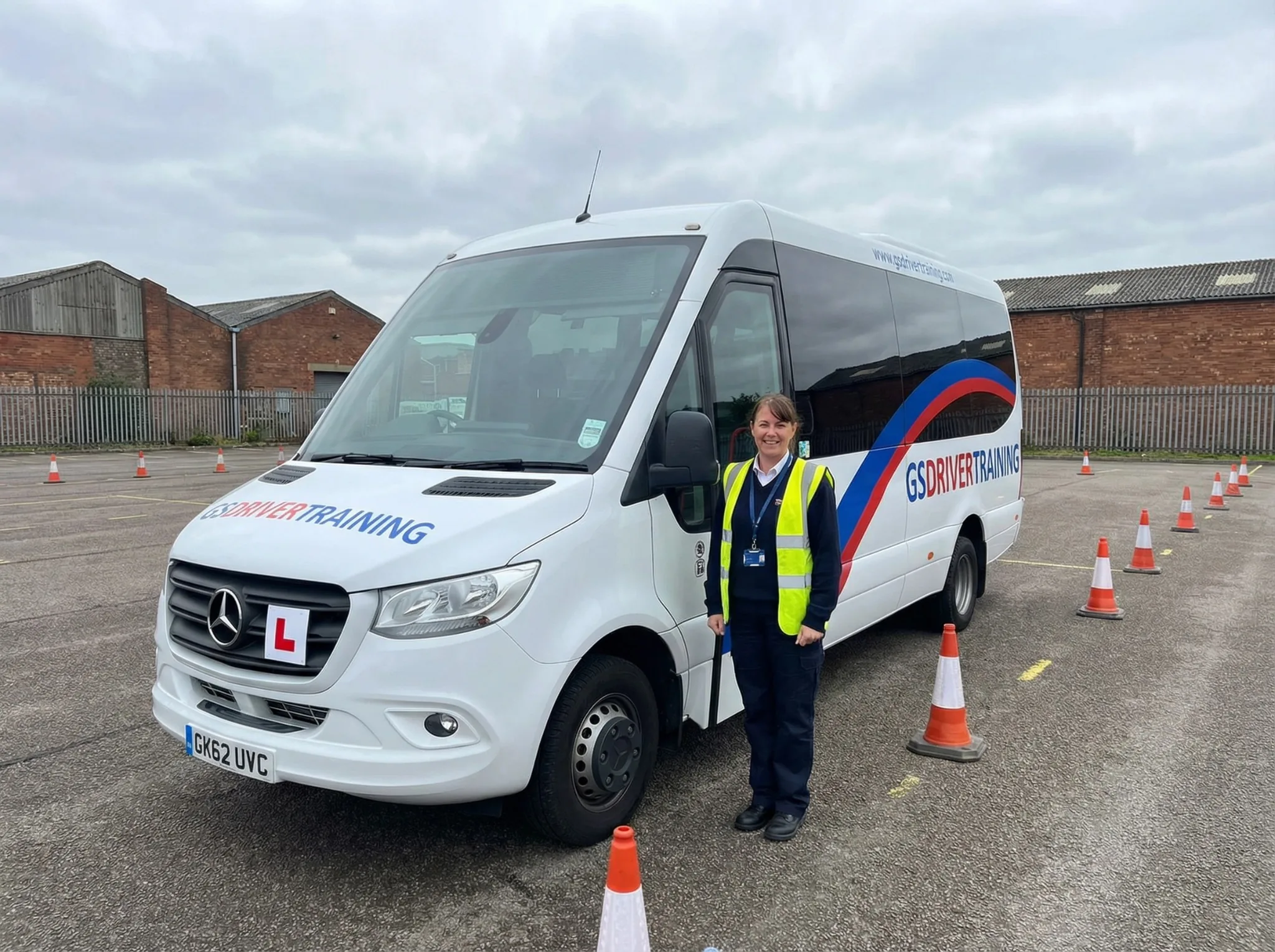
- The vehicle you will be tested in — this must be a minibus with 9–16 passenger seats, roadworthy, and insured for the test.
Your training school will normally arrange the test vehicle. Arrive at the test centre at least 10 minutes early to allow time to settle.
The Test Structure
| Section | Duration | What It Tests |
|---|---|---|
| Vehicle Safety Questions (Show Me / Tell Me) | 5–10 minutes | Knowledge of vehicle checks |
| On-Road Driving | ~60 minutes | Driving standard in real conditions |
| Reversing Exercise | 10–15 minutes | Vehicle control and observation |
Vehicle Safety Questions: Show Me / Tell Me
At the start of the test, the examiner will ask you two vehicle safety questions. One will be a "tell me" question — you explain how you would carry out a check — and one will be a "show me" question — you demonstrate the check on the vehicle. Common D1 minibus questions include:
- How would you check the tyre pressure is correct for this vehicle?
- Show me how you would check that the horn is working.
- Where is the emergency exit on this vehicle and how would you open it?
- How would you check that the headlights and tail lights are working?
- Show me how you would check the power-assisted steering is working before driving.
- How would you check the condition of the tyres?
Each incorrect answer counts as one driving fault. Two incorrect answers count as two driving faults. Practise these questions thoroughly with your instructor before the test.
The On-Road Driving Test
The on-road section lasts approximately 60 minutes and covers a variety of road types, including town driving, rural roads, and dual carriageways where available. The examiner will give you directions and may include a period of independent driving where you follow road signs or a sat-nav route.
The examiner is assessing your ability to:
- Drive safely and smoothly in a variety of conditions.
- Use mirrors correctly and systematically — particularly important in a minibus where blind spots are larger.
- Maintain appropriate speed and plan ahead.
- Position the vehicle correctly on the road, particularly on bends and when passing parked vehicles.
- Handle junctions, roundabouts, and traffic signals correctly.
- Give sufficient clearance to cyclists, pedestrians, and other vulnerable road users.
The Reversing Exercise
The reversing exercise requires you to reverse the minibus into a defined area, demonstrating control and all-round observation. This is one of the most challenging parts of the test for many candidates, as a minibus is significantly longer and wider than a car. Key points:
- Use all mirrors systematically throughout the manoeuvre.
- Move slowly and smoothly — control is more important than speed.
- Check your blind spots, particularly to the rear and sides.
- Do not mount the kerb or go outside the defined area.
Pass Marks and Faults
To pass the D1 test, you must:
- Not commit any serious or dangerous faults.
- Accumulate no more than 12 driving faults (minor faults).
A serious fault is one that has the potential to cause danger. A dangerous fault is one that causes actual danger. Either results in an immediate test failure. Driving faults (minors) are recorded for less serious errors, but accumulating too many of the same fault can result in it being upgraded to a serious fault.
Common Reasons for Failing the D1 Test
For a detailed breakdown of the most common D1 test failures and how to avoid them, see our dedicated guide: Top Reasons People Fail the D1 Minibus Test. In summary, the most frequent causes of failure are:
- Insufficient mirror use — particularly failing to check mirrors before changing speed or direction.
- Incorrect positioning — driving too close to the centre line or too far from the kerb.
- Poor speed planning — driving too slowly or failing to anticipate hazards early enough.
- Hesitation at junctions — waiting too long when it is safe to proceed.
- Insufficient clearance when passing parked vehicles or cyclists.
How to Prepare for the D1 Test
The most effective preparation is high-quality training with an experienced, DVSA-approved instructor. Beyond your training sessions, you should:
- Practise the Show Me / Tell Me questions until you can answer them confidently without prompting.
- Drive in a variety of conditions — not just the routes you know well.
- Ask your instructor for honest feedback after every session and focus on the areas where you are weakest.
- Get a good night's sleep before the test and eat a proper meal — fatigue and low blood sugar affect concentration.
D1 Test Preparation in Surrey
GS Driver Training prepares candidates for the D1 minibus test across Surrey and the South East. Our instructors know the local test routes and will ensure you are fully prepared for the specific conditions you will face on your test day. Call us on 01252 447808 to book your training.
Frequently Asked Questions
How many times can I take the D1 test?
There is no limit on the number of attempts, but you must wait at least 10 working days between tests. Each attempt requires a new test booking and fee payment.
Can I use my own vehicle for the D1 test?
Yes, provided it is a minibus with 9–16 passenger seats, is roadworthy, and is insured for the test. Your training school will normally arrange the test vehicle.
What happens if I fail the reversing exercise?
Failing the reversing exercise alone does not automatically fail the test — it depends on the nature of the fault. A serious or dangerous fault during the reversing exercise will fail the test, but minor faults are recorded and counted alongside those from the on-road section.
